February 16, 2026

Final consortium meeting

The OPENMIN consortium held its Final consortium meeting in Geneva on 16 February 2026, hosted by the University of Neuchâtel / Nccr - on the move team.

The morning session focused on updates and discussions related to:
> WP1 — Consolidating and Expanding Existing Open Science and Open Data (OS/OD) Tools and Infrastructure;
> WP2 — Exploiting Existing Results to Generate New OS/OD Tools and Infrastructure;
> WP3 — Delineating the Strategy and Roadmap for a European Research Infrastructure on Migration Studies.

Consortium members reviewed progress, addressed ongoing challenges, shared insights on technical and strategic developments, and discussed key strategic options and pathways for establishing such a European Infrastructure.
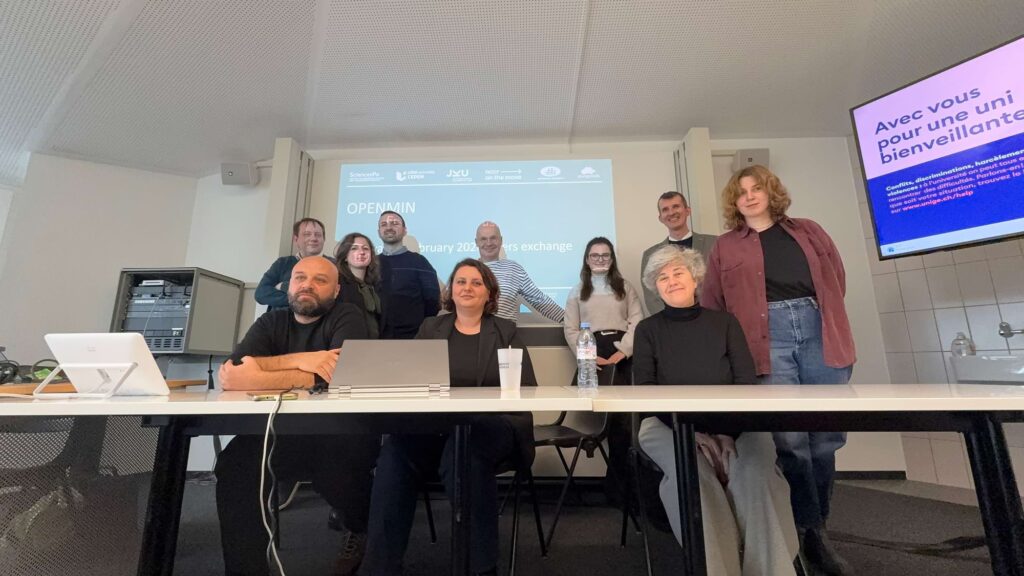
The afternoon session was dedicated to an open dialogue between OPENMIN consortium members and invited representatives from Geneva-based international organizations (UNHCR and WHO) and NGOs, including DIAC (Permanence et Observatoire contre le racisme antimusulman en Suisse) and Le Laboratoire. The discussion focused on identifying and sharing concrete data needs, as well as practical and institutional constraints related to migration and migrant integration data.

February 13, 2026

EMM Survey Registry updates

Over the last two years, the OPENMIN team has worked significantly to expand the metadata collection of the EMM Survey Registry. The Registry now includes over 2,100 surveys from 34 countries and is on track to add an additional 100+ new surveys within the next few weeks.

If you have conducted a quantitative, sample-based survey with EMM populations since 2021 in one of the 34 countries covered by the EMM Survey Registry, and your survey addresses at least one dimension of ethnic and migrant minority integration and/or inclusion, we invite you to contribute your survey metadata directly to the Registry through its backend. If you are interested, please follow the instructions provided on the EMM Survey Registry landing page.

Thank you for your ongoing support. We encourage you to share this announcement within your networks to help us strengthen this resource for the research community.

February 1, 2026

Survey Data Self-Deposit Dataverse (EMMSD²)

Within the OPENMIN project, the EMMSD² was developed as a dedicated self-deposit repository for EMM survey microdata, hosted by the Austrian CESSDA representative AUSSDA (the Austrian Social Science Data Archive).

The platform addresses a structural gap by enabling researchers and data owners without access to suitable national archives to deposit and share GDPR-compliant Scientific Use Files within the AUSSDA Dataverse infrastructure.

The repository is currently fully operational, with the first datasets deposited in 2025, and provides sustainable hosting, DOI assignment, and open access to datasets for scientific use. Interested users can get in touch with Dimitri Prandner (Dimitri.Prandner@jku.at) to sign up for the use of the tool or read the details on the AUSSDA EMM projects website about workflows and prerequisites.

January 10, 2026

The Survey Data Playground

Within the OPENMIN project, the Ethnic and Migrant Minorities (EMM) Survey Data Playground has been developed as a free online tool to make quantitative survey data on EMM populations accessible to users without advanced statistical software or programming skills.

The Playground enables interactive exploration and basic analysis of selected cross-national surveys through an intuitive web interface. Currently available in a pilot (alpha) version, it allows users to analyze selected questions and variables from a limited number of datasets, including
a) LOCALMULTIDEM and
b) a post-harmonized dataset on the Civic and Political Incorporation of Migrant Minorities.

Rather than simply displaying pre-calculated outputs, the tool organizes datasets into a structured and navigable system of themes, variables, and filters derived directly from the original codebooks. Currently, the Playground mainly serves as a proof of concept for transparent, standardized, and user-friendly online access to EMM survey data.

December 20, 2025

The Post-harmonized Survey Data Bank

Within the OPENMIN project, the Ethnic and Migrant Minorities (EMM) Post-Harmonized Survey Data Bank was developed to facilitate the reuse of independently produced surveys by integrating them into a set of single, standardized datasets.

The post-harmonization procedures are fully documented in publicly accessible Stata code, ensuring transparency, reproducibility, and comparability across the pooled datasets. The overarching goal is to enhance the reuse of survey data and to improve the accuracy and comparability of knowledge on the economic, social, and political integration and inclusion of EMMs across Europe. The tool is currently available in a pilot version.

This means that, currently, users can explore and analyze a limited number of post-harmonized datasets, with more to come soon. The post-harmonized survey datasets are publicly available via the EMM Survey Data Self-Deposit Dataverse, developed by AUSSDA. You can explore and analyze key variables on the EMM Data Playground, too!

December 15, 2025

Improvements to the EMM Survey Registry (2025)

In summary, the formulated plan included the following major groups of functionalities:

👤 Development of person-profile linking

To better highlight the researchers who contribute information to the registry, we propose adding a link between them (currently represented only as plain text) and their profile on an established platform (ORCID, MRH, or another).


🔐 Automation of the account creation process

To speed up the administration of information, we propose the automation of the account creation process. Invited researchers will be able to complete/edit their information themselves (not through a general system administrator, as is currently the case).


📊 Improvement of the information structure for each survey

Following intensive use of the system, several necessary changes to the original metadata structure related to each survey have been identified. We have created a new metadata scheme modified based on these conclusions.


🔁 Import-export templates

The platform will allow the export of lists with all the fields and all possible options (values). Based on this, we will define and streamline a process of saving a template that can be easier filled-in for improving the data-submission activity.


🔭 Source-code publishing

Publishing code is important for collaboration, transparency, and growth. It allows developers to share their work with a global community, receive feedback, and contribute to open-source projects. By making code publicly accessible, others can learn from it, report issues, or improve it through contributions. This not only enhances the quality and reliability of software but also helps build a developer’s portfolio, demonstrating their skills and commitment to best practices in software development.


All these functionalities have been implemented by youngminds (in relation with other partners of the project).

See progress report / 2025 (EN)

See progress report / 2025 (RO)

December 2, 2024

Improvements to the Migration Research Hub (2024)

In summary, the formulated plan and implementation included the following major groups of functionalities:

Updates and improvements to the current structure of the Migration Research Hub

These functionalities mainly aim to update the current features of the Hub as well as add support functionalities for future developments.


🔄 Re-running data import scripts and updating the database

The hub is based on metadata brought from many external sources (Clarivate – Web of Science, CrossRef, Unpaywall, other specific sources). In the past two years, these integrations have not been run regularly. This activity involves running the scripts and indexing a new batch of information so that the hub becomes "up-to-date."


🔗 Integration with the ETHMIG platform (https://registry.ethmigsurveydatahub.eu/)

The EMM (Ethnic and Migrant Minorities) Survey Registry is a unique platform dedicated to collecting, organizing, and disseminating information about surveys and research targeting ethnic minorities and migrants. The data published regularly on this platform is of interest to the Migration Research Hub, as this hub synthesizes and promotes a variety of relevant resources for migration research.


🔗 Integration with the ORCID platform

ORCID (Open Researcher and Contributor ID) is a global non-profit platform that provides a unique digital identifier for researchers and contributors across all academic and professional fields. This identifier helps resolve name ambiguity issues and increases the visibility and recognition of academic work. Researchers with ORCID accounts define relevant data about their academic activity on this platform. The integration between MRH and ORCID involves extracting relevant information for researchers who have accounts in the migration expert database (https://migrationresearch.com/experts) and also have ORCID accounts.


📧 Automated communication

This group of functionalities was inspired by other reputable platforms in the academic field (Google Scholar, PhilPapers, etc.) and concerns the creation of an automated system for notifying experts with accounts in the Migration Research Hub about new resources added to the database, taking into account several criteria:

  • Resources potentially attributable to each expert
  • Resources of interest to each expert, based on their associations with specific branches of the taxonomy at the core of the hub (https://migrationresearch.com/taxonomies)

All these functionalities have been implemented by youngminds (in relation with other partners of the project).

See progress report / 2024 (EN)

See progress report / 2024 (RO)

October 8, 2024

Creation of a new Self-Depositing Ethnic and Migrant Minorities Open Data Repository

Are you interested in contributing to the design of a self-deposit solution for survey data focused on migration research? Over the next year, OPENMIN will be working with AUSSDA – the Austrian Social Science Data Archive – to develop a self-deposit archiving system for migration-related survey studies. We are seeking limited, semi-regular input from researchers familiar with FAIR data principles and GDPR-compliant data practices, who would be interested in using this service. If you would like to participate, please contact Dimitri Prandner, the PI at our Austrian project partner, the Johannes Kepler University Linz through email at dimitri.prandner@jku.at by November 10th, 2024. Please note that, due to capacity limits, we may not be able to accommodate all expressions of interest during this initial phase.

August 25, 2024

Meeting at the IMISCOE 2024 conference in Lisbon

Exchanges around the options and roadmap for setting up a European infrastructure on Ethnic and Migrant Minorities and Migration studies research and data”

During the IMISCOE 2024 annual conference in Lisbon, members of the project met with the migration studies research community to exchange ideas, discuss needs, and explore opportunities for collaboration around Open Science and Open Data initiatives in the fields of Ethnic and Migrant Minorities and Migration Studies. The discussion focused on the potential development of a future EU infrastructure for migration research and data. 

As a first step, a Task Force was established, bringing together volunteers committed to advancing these exchanges and exploring the creation of a recognized European infrastructure for migration research and data. The Task Force held its inaugural meeting in early November 2024, where members began preliminary discussions on the path forward. We will share further updates on the Task Force's work in the next newsletter.

If you or your institution manages a regularly updated dataset on migration policy indicators, a tool for analyzing migration flows, a metadata repository, recurring training on migration research methods, a recurrent survey, or a research hub that integrates multiple data sources into new datasets or visualizations (to give just some examples), you are already operating a research infrastructure. If you recognize your project, service, or tool in these examples, or believe it qualifies as a research infrastructure in the field, we strongly encourage you to stay connected for updates and reach out to the project coordinators at ethmigsurveydata@sciencespo.fr.

June 15, 2024

EMM Survey Registry updates & Call for contributions

After a short break in the curation of new survey records, the EMM Survey Registry is back with updates and 102 new records, enhancing both its Ukrainian refugee and COVID-19 collections. Since June 2024, the OPENMIN team has ramped up efforts to expand the metadata collection, culminating in the release of version 2.0 in October 2024. The Registry now includes over 1,900 surveys from 34 countries and is on track to add an additional 100+ surveys within the next 3-4 months, potentially surpassing 2,000 surveys!

You can be part of this exciting milestone by contributing your metadata to the Registry! If you have produced survey data on COVID-19 (or its consequences) involving sizeable (sub)samples of EMM respondents (COVID-19 infosheets are available here in English, French and Spanish), a survey with Ukrainian or Syrian refugees or a survey with EMM populations more broadly, we invite you to contribute your survey metadata directly to the Registry. If you are interested in that, please follow the instructions provided on the EMM Survey Registry landing page.

Thank you for your continued support and please feel free to share this announcement within your networks.

The project is supported by the CHIST-ERA grant CHIST-ERA-22-ORD-07, by the French Agence Nationale de la Recherche (ANR), under the grant number ANR-23-CHRO-0007; the Swiss National Science Foundation, under the grant number OpenMin – U.03591.01 – FN20CH21_217517; the Polish National Science Centre, under the grant number UMO-2022/04/Y/HS6/00169; the Belgian Fund for Scientific Research (F.R.S.–FNRS), under the grant number  PINT-Multi- R.8006.23; and the Romanian Executive Agency for Higher Education, Research, Development and Innovation (UEFISCDI), under the grant number PN4-P8-272. The Austrian Contribution is sponsored by the Austrian Ministry of Education, Science and Research [Project Reference: 2021-0.459.811]

chist_era_logo
anr-logo-2021@2x
images
logo-ncn_en
logo@2x-EN
uefiscdi-logo-full-EN
BMF_Logo_srgb_EN
decor_openmin

© OPENMIN - 2026